
The Primal Sanctuary: Why Your Brain Craves a Jungle in the Age of Silicon
The Architecture of Our Discontent
We were never meant to live in boxes. For 99% of human history, our ancestors woke up to the fractured light of forest canopies and the intricate symmetry of blooming flora. Yet, today, the average urbanite spends 90% of their life indoors, encased in smooth, gray, sterile surfaces.
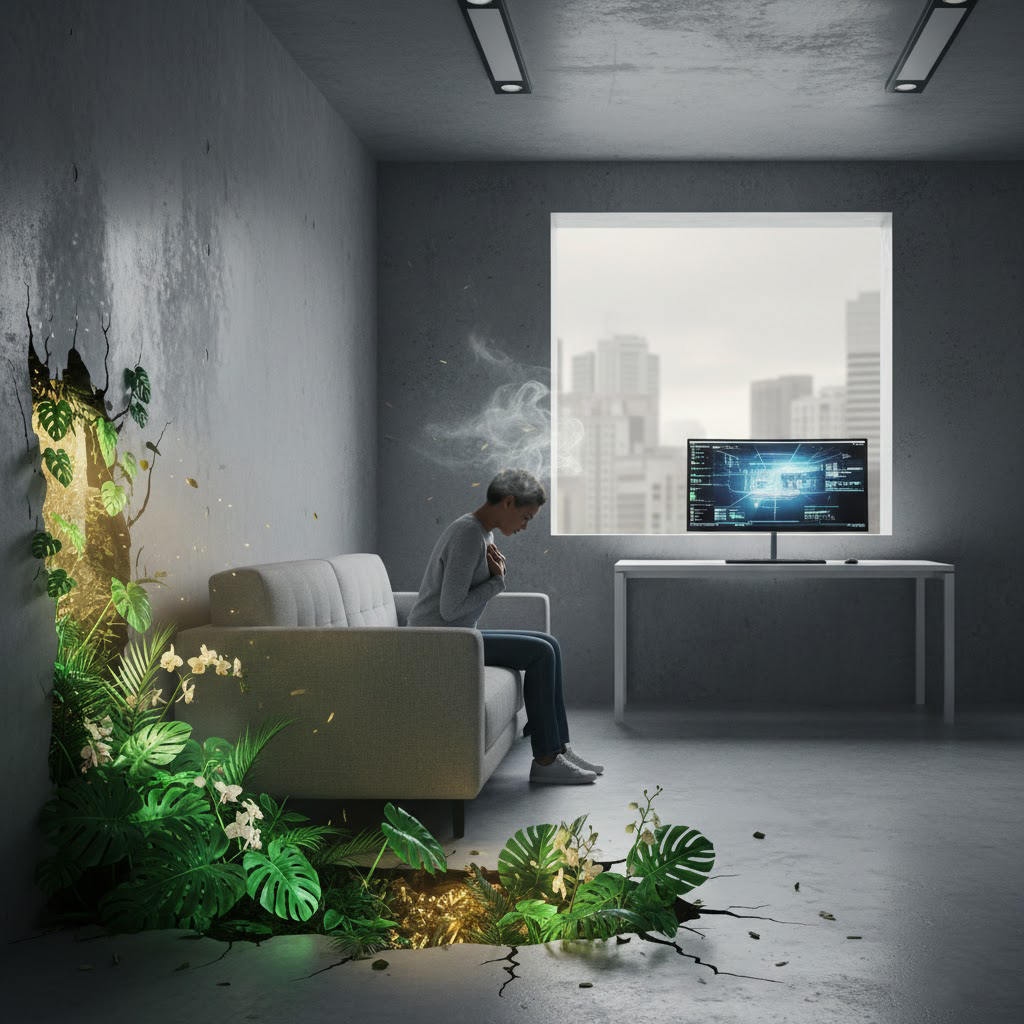
As a spatial psychologist, I see the toll this “concrete silence” takes on the human spirit. We call it “Nature Deficit Disorder.” It manifests in subtle, nagging ways: a persistent mental fog, a mysterious dip in creativity, and a sense of “urban claustrophobia”—the feeling that despite living in a city of millions, your soul is starving for breath. Your white walls aren’t just empty; they are echoes of a biological void.
The Sickness of the Sterile
When we suppress our innate connection to the wild—a concept known as Biophilia—our bodies react.
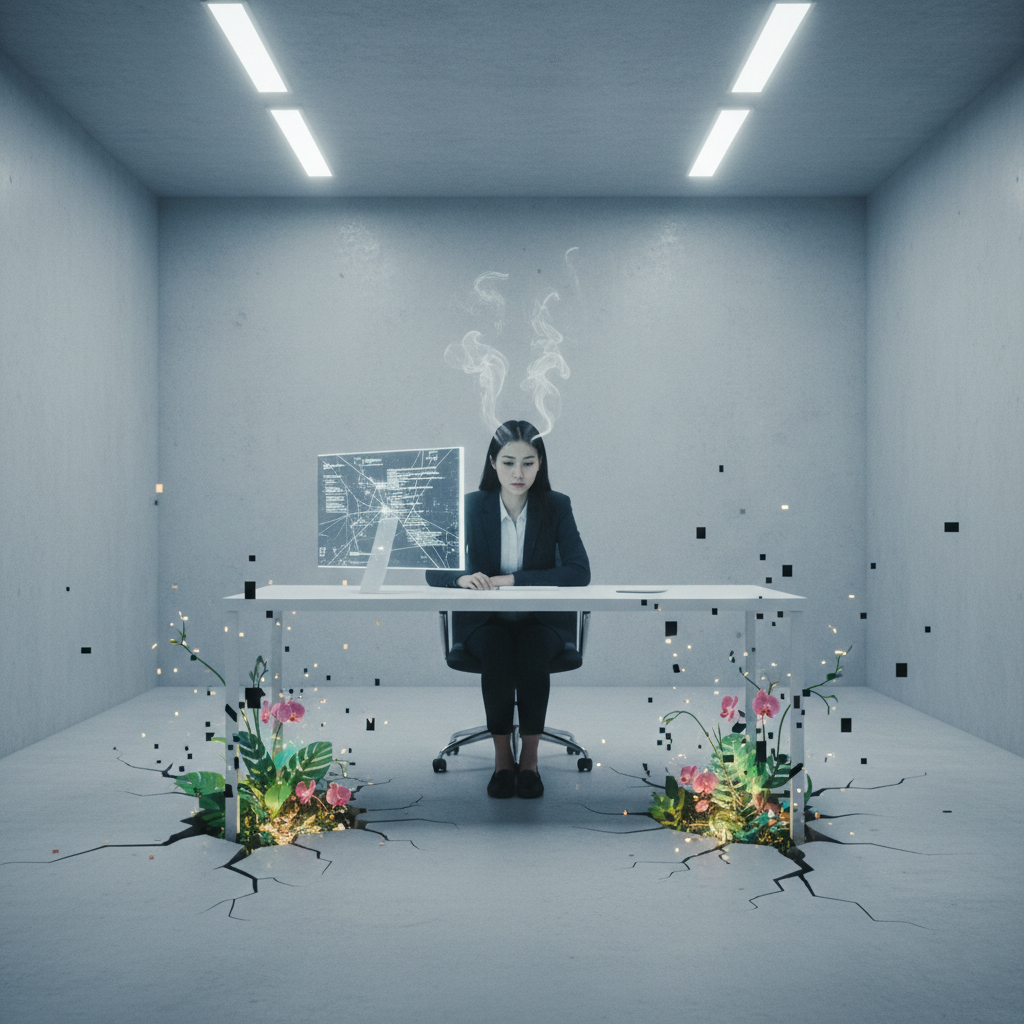
You might recognize these modern “micro-ailments”:
- Chromatic Deprivation: A subtle lethargy caused by a lack of vibrant color, leading to a “grayed-out” emotional state.
- The Flat-Surface Fatigue: The brain becomes under-stimulated by modern minimalism. Without visual complexity to explore, our focus fractures, leading to digital burnout.
- Concrete Anxiety: A subconscious stress response triggered by hard angles and synthetic materials, which the primal brain perceives as “hostile” or “unproductive” environments.
Maximalist Jungle: The Soul’s Antidote
Maximalism is often misunderstood as “clutter.” In reality, it is Sensory Richness. In the wild, there is no such thing as a blank space. A jungle is a symphony of detail, and our brains are hardwired to find peace in that complexity. This is where the Maximalist Jungle aesthetic moves from “decor” to “therapy.”
1. The Power of “The Guardian” Archetype
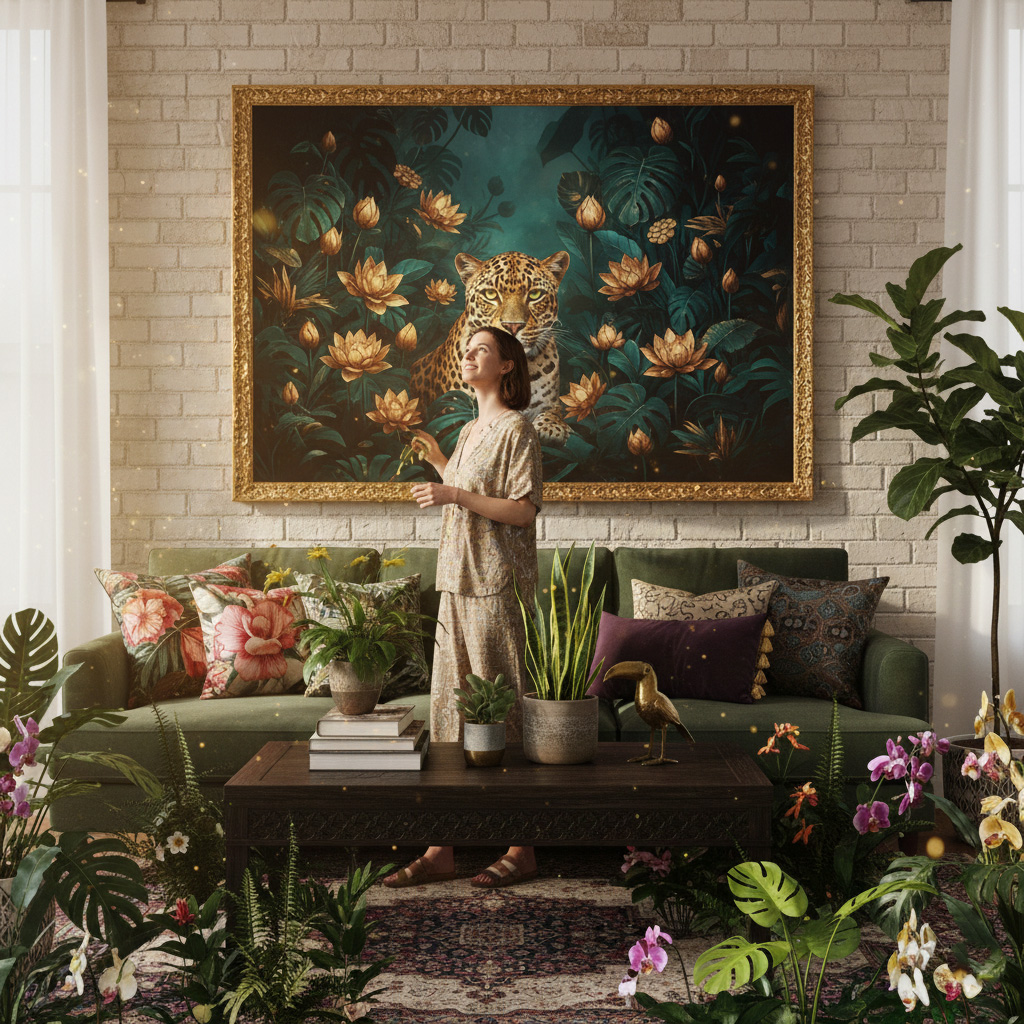
When you hang a portrait of a regal Leopard or a majestic Chimpanzee in your living room, you aren’t just buying art. You are introducing a “Guardian.” In evolutionary psychology, the presence of powerful wildlife signifies a thriving, resource-rich ecosystem. Seeing these “Lords of the Wild” in your sanctuary triggers a subconscious feeling of protection and primal confidence.
2. Healing through “Soft Fascination”
The intricate veins of a Monstera leaf and the shimmering gold of a Lotus flower provide what we call “Soft Fascination.” Unlike a glowing phone screen that demands your attention, these natural patterns allow your mind to wander and recover. They pull you out of the “urban grind” and into a state of rhythmic reflection.
3. The Emerald Sanctuary: A Healing Immersion
There is a profound biological reason our collection is anchored in Deep Emerald. This isn’t just a color; it’s a visual frequency of restoration. Science shows that immersing yourself in this specific shade of forest green triggers the parasympathetic nervous system, effectively lowering your heart rate and flushing out the cortisol built up from urban stress.
The Homecoming
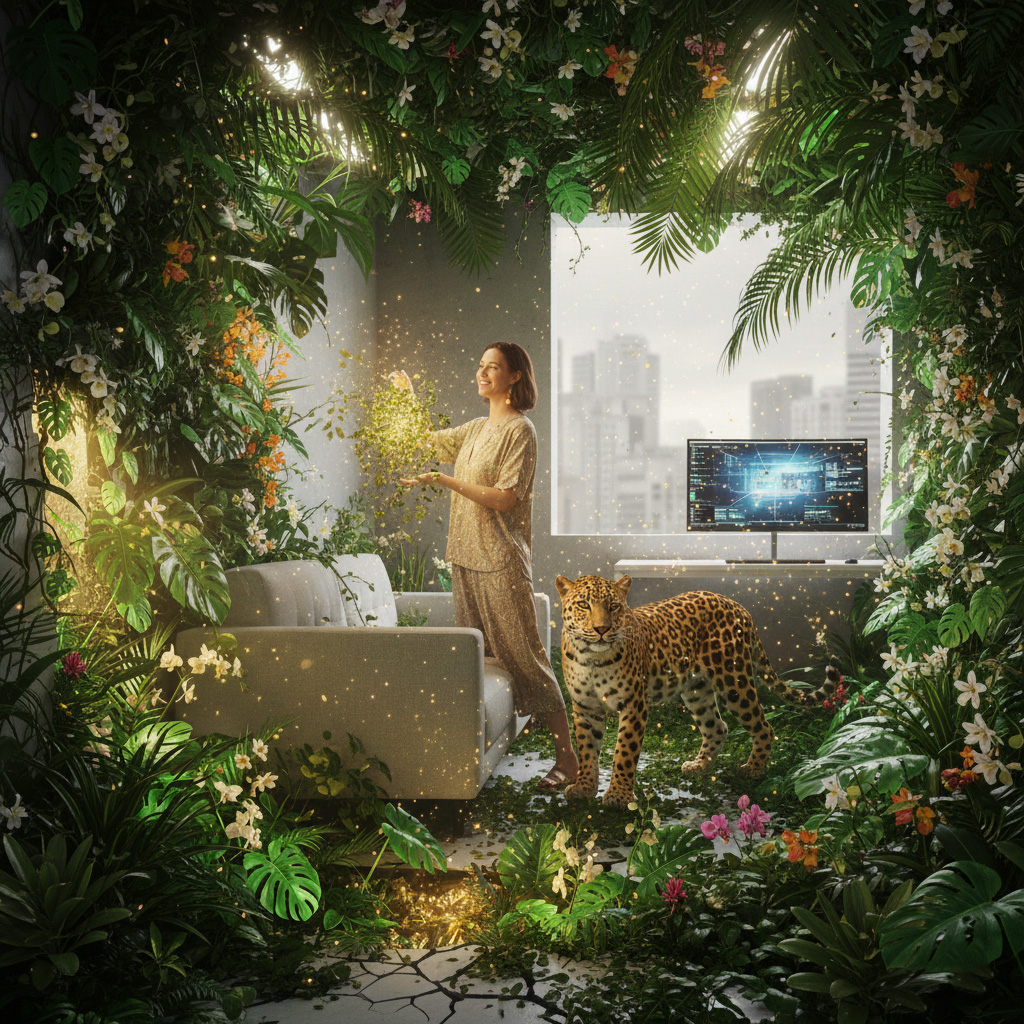
Your home should not be a gallery of silence; it should be an ecosystem of energy. By embracing the Maximalist Jungle, you are performing an act of Biological Rebellion. You are reclaiming the green that the concrete stole from you.
Trade the sterile for the spectacular. Trade the box for the brush. It’s time to stop decorating and start re-wilding your life.
Are you ready to bring the sanctuary home? Explore our [Maximalist Jungle Collection] and find the Guardian for your walls.

Q&A for the Maximalist Jungle Niche
Q1: I feel constantly drained and anxious in my modern apartment, even though it’s organized and minimal. Could my interior design be affecting my mental health?
A: Absolutely. Modern psychology identifies this as “Concrete Anxiety.” When we live in “boxes” with flat, sterile surfaces and sharp angles, our primal brain perceives the environment as hostile or stagnant. Research into Biophilia suggests that humans have an innate need for visual complexity. By switching to a Maximalist Jungle aesthetic, you introduce “Sensory Richness”—organic shapes, deep emerald tones, and wildlife imagery—which triggers the parasympathetic nervous system to lower stress and combat the “urban claustrophobia” you’re experiencing.
Q2: I love the look of the “Maximalist Jungle” style, but I’m afraid it will make my small home feel cluttered. Is there a psychological benefit to “more is more”?
A: While minimalism focuses on “less,” maximalism in a biophilic context focuses on “Life.” In nature, there is no such thing as a blank space. Evolutionarily, a “cluttered” or dense jungle signified a resource-rich, thriving environment to our ancestors. Psychologically, this density provides “Soft Fascination”—a state where your mind can wander through intricate patterns (like the veins of a Monstera leaf) without the “Flat-Surface Fatigue” of digital screens. It’s not clutter; it’s an ecosystem of energy that helps your brain recover from digital burnout.
Q3: Why are people choosing animal portraits, like Leopards or Chimpanzees, for their living rooms instead of traditional landscapes?
A: This taps into “The Guardian Archetype.” In evolutionary psychology, powerful wildlife represents a dominant, healthy ecosystem. Hanging a portrait of a Regal Leopard or a Majestic Chimpanzee isn’t just about aesthetics; it’s about introducing a “protector” into your sanctuary. These figures act as subconscious anchors for primal confidence and safety, helping urban dwellers feel more grounded and less vulnerable in a chaotic, concrete-heavy world.
Q4: I’ve heard about “Nature Deficit Disorder.” Can wall art really help if I can’t have a real garden in my city high-rise?
A: Yes. While real plants are ideal, the human brain is remarkably responsive to Visual Biophilia. A high-quality canvas print featuring Deep Emerald tones functions as a “visual frequency of restoration.” The brain processes these deep greens and organic floral patterns as biological signals of life. This act of “Biological Rebellion”—replacing gray walls with jungle imagery—effectively reduces cortisol levels and clears the “mental fog” associated with living in highly urbanized environments.
Q5: What is the best color palette to choose if I want to “re-wild” my home office for better productivity?
A: The most effective combination is Emerald and Gold. Emerald Green is the primary healer; it lowers the heart rate and provides the “Immersion” effect needed for deep focus. Gold (the color of sunlight) acts as the spark—it provides the warmth necessary to stave off “Chromatic Deprivation” and fuels motivation. Together, they create a “Wild Royalty” vibe that transforms a boring workspace into a soulful, high-energy empire. Bitnex Crestfort